I had a student this year who is originally from Columbia. One of the nicest kids I’ve had in a long time. Smart too. But since he’d only been in the country for a handful of years, he had some issues with comprehension, especially when it came to interpreting old primary source texts. That’s mostly what he’d ask me for help with in class. Beyond that, he excelled academically.
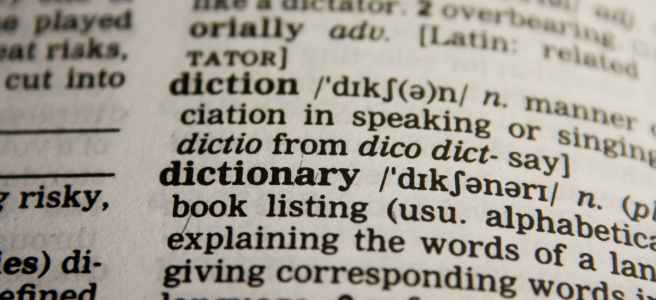
Folks say that English is very difficult for people to learn because of all of the idiosyncrasies present. It’s not just non-native speakers who struggle though. I’ve had my own share of problems, and so have many many other native English speakers. Three examples:
Commercial
There was an essay prompt on the AP US History exam recently that asked students about the commercial development of the US during the mid 1800s. Most of the essays I graded for this prompt were pretty straightforward, but a handful of kids got confused and took the prompt a different direction. They started writing about commercials…like print, radio, and/or TV commercials…instead of industrialization, which was the intent of the prompt. This was mildly entertaining since there were no radios or TVs during the time period in question. I think most of the kids knew that, but were confused by the word commercial.
Disbursement
I had two different part time jobs when I was in college. The first was as a delivery driver for a civil engineering company. The big perks there was that I didn’t have to use my own car, and I learned my way around Austin really well in the time before GPS was readily available.
The second job I had was working as an assistant at a small stock brokerage firm. I figured this job would go along better with my Economics degree. Maybe I’d get some practical experience. I did get some lessons early on, but not in the traditional sense.
The first thing I learned was that I didn’t know ANYTHING about the stock market or how brokerage accounts work. I could go on and on about that, but I’ll get back to the part about language instead. As an Economics major (and later, teacher) I learned very quickly that there is a whole other language set required in order to understand anything dealing with economics, finance, and accounting.
One of my first tasks at my new job seemed simple enough, but I managed to mess it up. I was told to label a manila folder with the heading “disbursements.” The problem was, I didn’t hear the word “disbursements.” I heard “dispersements,” which isn’t technically a word (even though disperse IS a word and I really really think dispersements should be a word…but I digress). So, I proceeded to write “dispersements” in the neatest handwriting I could muster (which is a big challenge for me), and then handed the folder to my supervisor, who proceeded to laugh so hard his face turned as red as his hair.
Normality
One of the more notable vocabulary issues that I talk about with my US History students most years happened during the Election of 1920. Republican candidate Warren G. Harding promised a “Return to Normalcy” after all of the Progressive reforms and fighting in World War I. Many people at the time thought Harding made up the word normalcy ($) since normality was much more commonly used at the time. He didn’t make up the word but it was typically used in mathematics and/or theology. But because Harding, who most historians rank as one of the worst presidents in US History, kept repeating normalcy in his speeches, it seems to have gained in popularity as a replacement of sorts for the word normality. I’m trying to think if I’ve ever in my life heard anyone actually say normality.
(So the part where a bad president repeats something over and over that at the time is unacceptable and then others repeat the same things and it becomes okay…that gets better, right?)
I think I’m going to keep writing dispersements again and again to see if I could make it mainstream.

 Reflections Of A Middle Aged Nobody